Thursday, June 26, 2008

On Gadgets

Let's consider the human brain as a computer, for a moment. There are three primary factors in a computer's performance: the bandwidth capacity (information coming from the external world, and the internal pathways), the processor capacity (how many tasks at each moment, and how fast it can finish each task), and the storage capacity, how much information can our brains usefully store.

The processing capacity of the human brain has not followed Moore's law. The processing speed of a human brain has not significantly improved in the recorded history.

The storage capacity of the human brain has also not significantly altered.

Similarly, the bandwidth capacity has also remained about the same.

But the information to process, and the number of tasks to be performed, and the number of things to remember have grown exponentially in the modern world. There is more and more data to process, and to store every day. And it is clogging the neural pipes, filling up the memory cells and stressing the processor.

We are more exposed to more information than ever before: There are hundreds and thousands of TV and radio channels, there are millions of books in print and available online and easily accessible (you can get them instantly via, e.g., the Amazon Kindle technology), we see thousands of advertisements every day, internet has opened up vast reservoirs of constantly updated information, there are hundreds of items in most urbanites' ToDo lists. There are unfinished books, half-listened songs, half-played games, undigested information, and so on.

Since the processing power has remained the same, while the information, task and storage load has increased, there is a lot of stress and a complete lack of "idle cycles". To augment our internal computing platform, we are constantly on the lookout for peripheral computers which can take some of the load away. These peripheral computers are what I call gadgets.

Every gadget dazzles you in the beginning but after being used for a while, leaves you somewhat unsatisfied. It helps somewhat, it takes some of the load away, but it also introduces overheads for its own maintenance (think anti-virus, think firmware upgrades, think repairs), and better gadgets arrive on the market every other day.

If you are a performance and efficiency fanatic, you will never be efficient enough in the modern world, because a new tool to make you even more efficient would have just arrived on the shelves.

The use of gadgets to have more leisure is self-defeating. Despite your best intentions, the more and better gadgets you have, the lesser will be the amount of leisure you will have.

This is not paradoxical, but quite logical.

Gadgets enable you to do business and "entertain" yourself no matter where you are. The problem they solve is not you having less leisure, the problem they solve is you not being able to do what you want when you want it.

Since gadgets enable you to do almost everything anywhere, and they enable you to process the information faster and more efficiently, they therefore take away your leisure. Why?

I think that this conundrum of power and efficiency versus leisure is extremely important in the modern age. People are chasing power, thinking that ultimately they will be powerful enough to have leisure, people are chasing efficiency, thinking that ultimately the efficiency will guarantee idle time, people are chasing optimization, thinking that ceaseless optimization will make them carefree. And tools for optimizing and increasing your efficiency are seemingly all over the place, and increasing in number, the chase is never-ending.

It doesn't work like that.

It doesn't, because the incoming information load is not letting up, it is actually becoming faster and heavier. The more you process, the more you still have to process. You can have leisure only if you cut the information cords, if you remain content with the fact that you will miss out on the new new things but you will enjoy more what you have.

Optimization and efficiency would work only if there was a finite amount of information to process, and a fixed number of tasks to be performed in a fixed amount of time. People ignore the frenetically accelerating dynamic of today's life when they start chasing efficiency with better and better gadgets.

One sees youngsters lost in themselves wearing iPod headsets in buses and trains (and complaining that 20GB storage isn't enough), kids playing cellphone games while waiting in a queue (and complaining that their cellphones are too slow), adults flipping TV channels and watching two programs at once using the Picture in Picture technology (and complaining that a particular channel doesn't offer HD resolution), and almost nobody saying that they have powerful enough computers.


The ever-increasing load of unprocessed information (which one thinks might contain that knock of destiny and fulfillment somewhere) leads one to feel as if one is missing out by just not being able to process information better, or by not being able to store it better for later processing.

Hence, more gadgets. Hence, more storage. Hence, more anxiety.

And the more worked-up we are at the surface level, the less is our quality of output, the less the refinement of our thoughts, the slower the evolution of our fundamental basis.

And with technophiles, a gadget becomes a fascination in itself. Their ends and means are both gadgets. They revel not in what the gadgets can do for them, but in what the gadgets can do, period. So too with people who regard gadgets as status symbols. If you ask someone proud of his new phone, he will describe all the new features, the increased resolution of the camera, the increased storage for the songs, the better connectivity the phone has, etc. But if you ask him whether the phone has improved his quality of life, he will look at you as if you haven't understood the features yet.

(When I was pursuing my engineering degree, I reveled in just installing new compilers on the latest servers. And I used the latest compilers to compile new tools, editors and so on. Being on the cutting edge, having the latest tools was what was important. I had no clue as to how the tools could be best used. Only many years later I realized that a second-best tool used productively is infinitely better than a latest tool just sitting idle and shiny. I am now fine with writing and working on a last-generation computer, using emacs text mode as my editor.).

The quality of life is not about band-width, it is about band-depth.

The depth (and hence the quality) of your engagement in life can only become better if you invest not in power and efficiency, but in filtering out, having fewer (but more creative) things to do, having less (but more tangibly useful) information to process, having less (but more often used) possessions to store and maintain. Dis-engage, retreat, cut-off your high-bandwidth inbound cords for a few hours every day, for a few days every month, for a few weeks every year.

For the sake of whatever is important in your life, SLOW DOWN.

Thursday, June 19, 2008

On Homophobia

Why is there such a vitriolic hate in some people against gays and lesbians? After all, people have all kinds of preferences, so why is this preference considered so hateful? I don't want to argue whether homosexuality is a genetic predisposition or if it is a after-birth preference. I only want to address the issue of homophobia. In many countries, including India, homosexuality is a crime under law. Why?


Firstly, it is clear that sexuality in human beings has evolved with reproduction as its function. The ejaculation of sperm in male orgasm and the menstrual cycle in the female are proof enough that sexual organs are to propagate genes by reproduction. Hence, the first charge against homosexuals is that of "perverting" (assuming they had a choice in the matter) a fundamental natural principle of the human body.

Secondly, since sex for homosexuals has no reproductive function, what function does it serve? Pleasure, of course. And sexual pleasure is anathema (hypocritically of course) to most conservative societies and religious groups. Homosexuals are therefore an easy target for the charge of sinful fornication and pleasure seeking.

Thirdly, in many patriarchal societies, young males are prized possessions. Their violation by elder males for sexual pleasure is considered a graver offense than the rape of a woman or of a young girl. If a young male is lost due to a sexually transmitted disease, or if he loses his "manhood" by becoming psychologically feminine due to sodomy, it is considered a great loss for the community. So also, an adult homosexual with effeminate behavior is considered an embarrassment for the male community in general, and one who is considered a liability and not an asset in case of conflict.

A woman who chooses to have only lesbian relationships is seen as an insult to the males whom (according to the males) she does not find desirable enough to have sexual relations with. This rouses much rage in a conservative patriarchal society.

Fourthly, there are various groups in society where cohesion exists because of the absence (or the assumption of absence) of sexual tension and sexual competition. Male clubs, fighting collectives (e.g. in the army or navy), female gossip groups (e.g. kitty parties), sexually segregated religious gatherings (e.g. in mosques, Sikh temples, Hindu temples, Christian churches, etc.) all assume that there will be no sexual complications in their gender-segregated groups. Once a person in such groups is known to be homosexual, he/she is shunted out because to keep him/her in the group will mean that others cannot relate to him/her as sexually neutral (they are also now the potential objects of his/her sexuality).

Fifthly, by the very nature of sex, one finds pleasure in mundane bodily fluids (saliva and sweat) and gender-neutral objects such as hair, hands and lips. This pleasure is associated with such fluids and objects because of the underlying gender of the other's body, and not because of the objects on their own. These fluids and objects are normally not considered attractive (they may in fact be considered repulsive) when observed in the person of someone of the same gender as oneself. Hence, the awareness that another person (having these unattractive or repulsive attributes) is looking at oneself with longing at some level, is enough to cause consternation and revulsion in heterosexual people. After all, males will frequently overlook a female's superficial attributes and have sex with her anyway because she is after all, a female and is attractive because of that important fact. On the other hand, it is extremely hard for a heterosexual male to tolerate, e.g. while in a conversation, even the flying specks of saliva of a moderately attractive male.

Sixthly, since society has established taboos against homosexuality at various levels, it is an open challenge to society and its stability for some people to rebel as far as sexual preferences are concerned. There are various taboos and restrictions on sex of all kinds, but one may still be able to hide sexual kinks insofar as they are had with a person of another gender. Having multiple partners is also permitted in various ways in many societies. But having a partner itself from the "wrong" gender is considered a grave wrong.

Seventh, since this is such a strong taboo, homosexuals grow up to have feelings of isolation, being repressed and being alienated. Sexual orientation for them becomes a focal point in their lives. "Coming out" becomes a big thing. Once out in the open, they wear their sexuality on their sleeve, as it were (it is debatable whether this is due to feelings of triumph, or due to an attitude of cocking a snook at society, or a consequence of just letting it all out after a long period of repression).

Frequently (this is only my opinion however, and I might be wrong), homosexuals seem to be very conscious of their sexuality, sexuality seems to occupy a large part in their lives and in their behaviour (more than normal people) and others cannot fail to notice it. Now even the so-called liberals, who have grown up to consider homosexuality as a tolerable form of behaviour, are outraged. It is one thing, according to them, to be homosexual, but quite another to be blatantly sexual, touchy-feely etc. even in normal social discourse. This is abhorrent to many who otherwise think homosexuality is in principle OK. This feeling, coupled with a guarded attitude lest one become an inadvertent object of the other's affections, leads most people to avoid homosexuals in social settings.

Eighth, homosexuals (especially males) are at increased risk of sexually transmitted diseases such as AIDS and an increased risk profile leads others to incorrectly see them as diseased already. Since most people are uneducated about the infection vectors of AIDS and other STDs, they avoid this high-risk category altogether, lest a handshake or the sharing of a toilet seat lead to some life-threatening illness.

Finally, homosexuals are stereotypically seen as flagrantly promiscuous and unwilling or unable to hold long term relationships, and this raises even more heckles in "normal" people (hypocritically of course). After all, they think, not only do you have to be "perverse", you have to exercise your perversity to the fullest extent possible, eh?

The end result is that homosexuals typically feel comfortable only in the company of other homosexuals. Hence the emergence of gay bars, clubs and such.

Tuesday, June 03, 2008

Silent Light by Carlos Reygadas

A film with an absolutely stunning beginning and ending, two shots that leaves one spellbound in their beauty, sublimity and enormity, is an achievement in itself. But the director Carlos Reygadas from Mexico has done much more in the two hours than only create these two moments.


A meditative film about transgression and regret and about the understanding of human fallibility, Silent Light is silent about what it wants to say. It does not judge the sinner-saints of this film, but lets the silent awareness of their acts and lives seep into you, as slowly and beautifully as a dewdrop falling from the petals of a flower.


This film is the state of the art in so many different arenas, be it composition, editing, fluid camera work, sound design, un-self-conscious acting, the understatement of its narrative (except at one point), that it can be justifiably considered a film with the strength to re-create the "magic" of cinema. Having seen hundreds and thousands of films, one sometimes is in the danger of not being affected by even the most harrowing of screen-moments, but this film silently creates a mood so powerful from its bare and sparse scenes that at the end, when the sun moves in a golden arc through the tree, one's hands are folded almost in prayer at having witnessed something whose simple power comes not from manipulation but from an unfathomable depth of what it means to be a limited, temporary consciousness in an eternal, infinite universe.


In this film, the movement of the camera has a unique stillness and calm, even when it is in the process of witnessing an unbearable tragedy. Each mundane moment of a family suspended in the delineated duration between birth and death is cinema at its purest: the creation of an uncommon piercing mood from the most ordinary of events. The dinner table, the kiss, the pond, the hotel room, the watching of TV, the sipping of tea at a ceremony, the driving of a car, the passage of the sun and the stars, ...

Two scenes especially are impossible to forget. Johan's breaking down in the beginning, and his kiss with Marianne at the hillside. The artistry and the realism is too formidable for words, and I daresay that no man has ever cried on screen like Johan in this film, and that that is what crying is like in real life. And also, I can unhesitatingly claim that there has not been a kiss in the history of cinema to match the kiss of Johan and Marianne.

If Irreversible by Gaspar Noe was a journey through the nether world of urban nihilism and the futility of regret, this film is a voyage through the tranquility of rural life, the reversing of time and the transcending power of realizing one's mistakes. In Silent Light, the skyscape is clouded at the beginning. At the end, when it clears up after having been through a storm, it is as if it was a single day in the universe.

The symbolism is not very hard, though pervasive in the film. When Johan is circling at the garage, it is as if he is going around in circles in his giddy self-concern, with no end in sight. When Johan stops the clock at the beginning, it is as if he does not want too much time to pass before he makes up his mind because he knows the cost of time. When Marianne shields herself from the sun, she is shielding herself from the stark light of realization. When Esther is harvesting the field, she is crushed and torn apart and being churned inside. When the car is on the unpaved road, alone, it is a symbol of Johan in his inner turmoil and noise. When the parents are in the barn, with cows slowly occupying their place, it shows the certainty, security and understanding born of time and habit. When the two hotel rooms are shown, we are not sure where Johan is, which woman he belongs to. The two rooms are identical, with one having more mature trees at the outside. At the pond, some children frolic, some dive in hesitatingly, some stay outside: the diverse attitudes to the risks one has to take in life.

This is a film of homage by the director to the various "saints" before him: Dreyer, Ozu, Bresson, Tarkovsky, Bergman. And this is therefore not just a film, but is also a pilgrimage.

I have been privileged to watch this.

Tuesday, May 27, 2008

On Adventure

For the educated, well-fed and prosperous minority amongst us, the challenges of life are now intellectual, narrowly emotional, hedonistic or cognitive. There are many amongst us who feel numb in this environment and crave physical and primitive challenges, the rush of adrenaline and endorphins, the sweet tiredness of physical exertion and the taste of food when really hungry, a loaded battle with the elements of nature, the solitude of forests and mountain paths, a return to the basics of life, ... at least for a weekend.

For all the mindless distractions of city life, there are those amongst us who still find it meaningful to dump it all and sweat again while climbing a hill.

For a person who is living in the hills, fields or forests, the need for such adventures is non-existent. His daily life has enough interactions with other life forms and with unforeseen primitive challenges. For such a person to see well-heeled urbanites come from hundreds of kilometers away to trek on a path that he/she visits every other week, to climb down a rope from a high rock, to pay thousands of rupees for a rocking ride over the river rapids, to jump from a cliff with a parachute or a bungee cord, leads to incredulity and derision.


There is an artificiality to planned adventures which is hard to miss. Yes, we are trekking and climbing and punishing ourselves in order to enjoy the primitive challenges; but how can we escape the contradiction of our being more than prepared with our Timberland shoes, mineral water bottles, junk food snacks, cameras ready to click any shadow of a wild animal or bird, the North Face apparel, imported camping equipment and the very tangible sensation of being outsiders who are consuming nature, just like we consume and shop in the cities?

The joint effort of Sir Edmund Hillary and the Tibetan Sherpa Tenzing Norgay to "conquer" Everest is illustrative. The westerners saw the mountain as something to conquer, whereas it was an object of veneration for the Buddhists, who used the word Chomolungma (the Mother Goddess) for Everest. It is one thing to live in a challenging terrain and climb the hills which are close to one's home, it is quite another to take a plane to another continent and spend hundreds of thousands of dollars to climb a hill for fame or self-satisfaction. It is notable that the Sherpa was not honored with a Knighthood (he was refused) while Sir Hillary was singled out for many honors. The Sherpa was however venerated as a higher being in his own villages.

Though Edmund Hillary worked for the Sherpa community after his "conquest" of Everest, the difference between his attitude and that of Tenzing Norgay is best exemplified by his utterance when he met George Lowe after his ascent: "Well, George, we knocked the bastard off."

...

Instead of living a life more in harmony with the Earth and nature, adventure junkies have turned natural habitats into playgrounds for their egos. There is a whole spectrum of adventure-consumerists: those who flinch at the sight of a single coke can on a mountain trek and who are primarily nature-lovers, to those who go to wilderness as a retreat from a stressful life, to those who deface barren rocks with admissions of their crushes and affairs and only have adventures for bragging rights and photo opportunities.

It is not easy to give up the distractions, the lifestyle and the career opportunities of a big city and move to the countryside or to a remote region, and the planning of "wilderness trips", "treks" and "adventure sports" is perhaps an admission of this helplessness. One does crave a connection with nature, but can only afford a temporary, highly planned adventure.

The psychic pollution in a large city can exhaust the nerves and make one want to escape. Going back to nature does give one a taste of that lost silence and innocence, but the bigger malaise of one living an increasingly artificial life, cut off from the sensual diversity of a natural habitat but having an unmanageable amount and diversity of mental distractions, is left intact.

...

So what is a man to do? Recognize the artificiality, the cognitive and psychic overload of the big-city life, reject its advances as far as possible; spend some time on one's own (nothing rejuvenates as much as solitude), and spend long vacations in nature without the craving for adventure or adrenaline. The return to nature is a return to elements. If one is seeking "experiences" in nature, it is like shining a torch in broad daylight.

While in a forest, or on a hill, or on the beach, relax... There is nothing to be done, or to prove anything to anyone, or anything to capture in your camera. Let nature act. Become a part of it, rather than a consumer. Let the moment have you, rather than "you" gloating at the moment.

I know how it feels to enter the insane, polluted, crowded, shrieking man-made world of the big city after having had the experience (one cannot fail to catch a taste of the silence and the wilderness despite all the efforts one might have made to spoil it by the habitual seeking) of a nature retreat, and one wonders when humanity will learn to avoid its self-destructive ways of unbridled distraction and self-centered hedonism.

Monday, May 26, 2008

Cooling machines and their health effects

In India, the urban middle class primarily uses two appliances, desert coolers and air conditioners, for cooling the interiors in the summer and monsoon seasons.

The weather in summers is quite hot in the sea-level regions of India. In North India, the states of Punjab, Haryna and Delhi have temperatures as high as 48 degrees Celsius. The relative humidity can be as high as 80. In south Indian coastal regions, humidity is consistently high and can quickly lead to heat exhaustion.

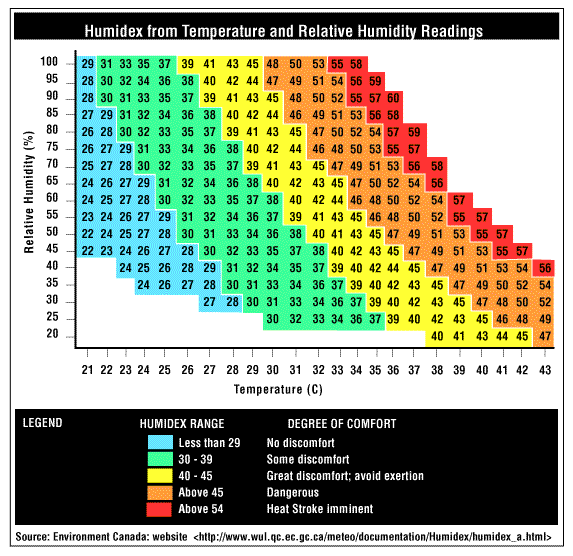
A combined index called Humidex takes into account both the relative humidity and the temperature to calculate values suitable for humans. Humidex is used by Canadian meteorologists whereas a related index, the Heat Index, is used by US meteorologists. The calculation of the Heat Index uses the Dew Point for humidity rather than the relative humidity.

According to some official studies, a Humidex value of 20 to 30 is considered comfortable, with a value between 30 and 40 indicating mild discomfort. Values above 45 are considered dangerous. Since Humidex is calculated from two variables, a single Humidex value can have multiple possible temperature and humidity values. For example, a Humidex value of 25, for example, can either be temperature/humidity values of 22/60 or 24/40.


If we take the average humidity in June in Delhi as 60, and the average temperature as 40 degrees (this is from 2007 data), the Humidex value is 57, indicating imminent heat stroke. The values are more comfortable indoors, but even a Humidex value of 50 is considered extremely dangerous by the studies.

No wonder anyone who can afford it goes in for cooling appliances. Before 70s, only ceiling fans were being used widely in India. 70s and 80s can be considered the era of evaporative or desert coolers, with ACs becoming affordable in early 90s for a sizable section of Indian middle class (no doubt helped by the higher incomes and availability of credit). Desert coolers are still widely used by lower middle classes. The initial and running cost of a desert cooler is only one fifth of that of an air conditioner.

Desert Coolers

Desert coolers use wet pads and a blower fan in an enclosed box. The pads are kept wet by a small pump which pumps water from a tub attached to the blower box. In dry heat, desert coolers are quite effective in cooling the interiors but when the relative humidity is high, their effectiveness diminishes greatly and they may even cause swamp-like suffocating conditions inside the room.


Compared to the air conditioners, they use fresh air from the outside and do not circulate stale air already inside the room.

But their effectiveness greatly diminishes when the air is already humid. High humidity rates makes the skin and eyes wet, and can cause problems in the lungs. The air supplied by the coolers is typically of 80-90% relative humidity which reduces the evaporation rate of the body. Since the desert cooler wet pads are not dense enough to filter air completely, pollen, various microorganisms, contaminants can be blown in by the cooler fan. Certain bacteria and mosquitoes breed more effectively in humid atmospheres (as also in the water tub of the cooler) and can cause significant health risks.

Air Conditioners

Air conditioners cool air as well as remove humidity. Simplistically speaking, they do it by passing the air through coils filled with compressed gas. The gas expands by taking heat away from the air, and a blower sends the cooled air into the room.

The coils are cooler than the environment and as such, they take moisture away from the air due to condensation. Unless a humidifier is built into the air conditioning unit, the air inside a normally air-conditioned room is very dry.


Most normal air conditioners sold as window ACs or split ACs have no humidity control or humidifier units. Expensive unit, not available in India, route the condensation and heat back into the room to control humidity.

Air conditioners usually have filters which clean the air as it passes through it. If the filters or the inside of an air conditioner is dirty, it can introduce various kinds of mold and microorganisms in the cool air which can exacerbate asthmatic attacks and cause ill-health.

Low levels of humidity can cause dryness of skin and eyes, irritation in the throat and lungs, headaches and overall discomforts. At humidity levels of 30, the minimum comfortable temperature is 27. Prolonged exposure to low-temperature low-humidity environment will lead to respiratory and skin discomfort.

Many low-end air conditioners also lead to a lack of fresh air and oxygen in the room. It is easy to smell the stale air in a room after an overnight run of a non-vented air conditioner. Split ACs especially have no access to fresh air and only cool the inside air and remove humidity from the room. Split units should only be installed in showrooms and high door opening frequency areas.

Conclusions

The air inside a house should be reasonably cool, reasonably moist, reasonably clean and reasonably fresh. Air coolers provide a lot of fresh air, but can cause excessive humidity. Window air conditioners remove moisture from the room. When using an AC without a built-in humidifier, the ideal setting is to have a temperature setting of 27 and above, with open vents to allow in fresh air. Split air conditioners should be avoided in home settings.

In case one is using a desert cooler, a dehumidifier unit (not easily available in India) can be used. If a dehumidifier is not available, desert coolers should not be used in high-humidity conditions.

In case one is using a window AC and the air is getting too dry for comfort, a humidifier unit (or a toy fountain etc.) can be used to introduce humidity in the room. In case no humidifier is easily available, one can make one's own by having a pan of water over a portable electrical hot plate. The water vapor will not let humidity in the room go down to dangerous levels.

If the room is not big, one can also use a portable steam inhaler (easily available for Rs 150 in a roadside chemist shop). The only downside to using an inhaler as a humidifier is that the content of water is very limited and it may only work for a few hours. The market may be ripe for a portable humidifier costing a few hundred rupees which will come in very handy in winter months as well when humidity is very low and people use room heaters and heat convectors.

In any case, the various pads, filters and internal casing of the cooling unit must be periodically cleaned to avoid fungus/mold, bacteria and dust.

If the air conditioner does not have a vent for fresh air, leaving open a small window is a very good idea.

References

http://en.wikipedia.org/wiki/Air_conditioner

http://en.wikipedia.org/wiki/Air_cooler

http://en.wikipedia.org/wiki/Humidex

http://en.wikipedia.org/wiki/Heat_index

http://www.ccohs.ca/oshanswers/phys_agents/humidex.html

http://www.mouthshut.com/review/General_Advice_on_Air_Conditioners-131230-1.html

http://www.wunderground.com/history/airport/VIDP/2007/6/25/MonthlyHistory.html?MR=1

http://en.wikipedia.org/wiki/Humidifier