For more details:
http://www.rationalistinternational.net/article/2008/20080310/en_1.html
From "The Rationalist International":
The story of Sanal Edamaruku challenging India's top tantrik Surinder Sharma on live TV to demonstrate his magic powers on him raised enthusiasm and curiosity all around the world. Our website got nearly two million hits in two weeks. We received hundreds of appreciative letters and congratulations every day. One of the first reactions came from James Randi: "Sanal! My congratulations for this excellent demonstration of rationality over superstition", he wrote, "reason has won the day".
The story appeared on SWIFT (web page of the James Randi Educational Foundation) and on Richard Dawkins' website, to name the two most prominent. Meantime it has been overtaken by hundreds of sites and blogs and is touring the Internet in many languages.
Youtube videos available:
Part 1: http://www.youtube.com/v/qNoX0XKUZlk
Part 2: http://www.youtube.com/v/T7MtG7qOj9E
Part 3: http://www.youtube.com/v/kol01I-Ll2s
Sunday, March 30, 2008


Madame Tutli Putli by Chris Lavis and Maciek Szczerbowski
A silent, claymation film 17 minutes in length, but what an astonishing film!
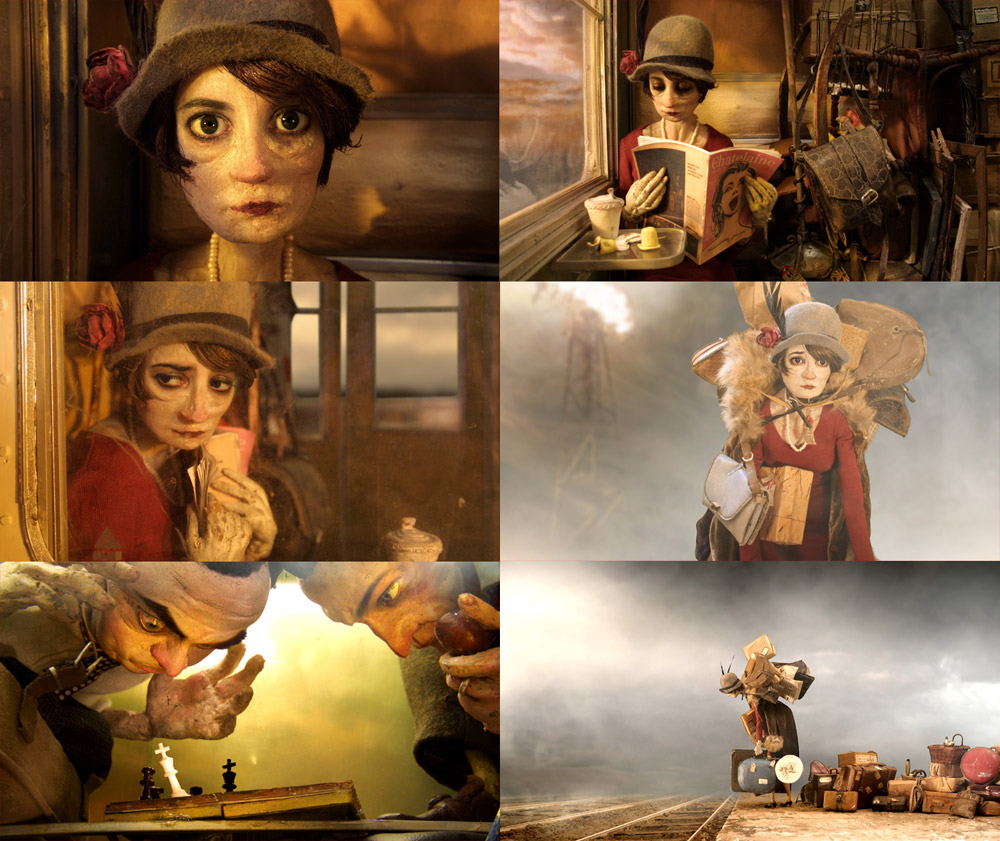
A woman, carrying the baggage, memories, loves and aches perhaps of many lives, boards a train, a train that almost blows her away as it is arriving (the cataclysm of birth).
The train journey is the journey of life, one where we can look around in the compartment, but where the path and the milestones are not in our control. We have chosen a destiny, a destination when we buy the ticket, but how we get there is not up to us. Life is too vast and the future imponderable in essence.
And as she boards the train and watches the stations pass her by from her window seat, through the glass... The glass that gets increasingly blurred and dusty as the journey progresses. The glass is our psyche, one which colors every perception.
Two men, just above play a wondrous game of chess in which the moves are made not by them but by the jolts of the train. What a stunning analogy of life's events. The loser clasps his hands in desperation, and the winner congratulates himself. Both know that their achievement, or their loss, is circumstantial but still cannot help feeling what they feel.
Then she encounters a lecherous man, in what is perhaps the most un-subtle of her agonizing moments.
The train stops as if willed by some powers, and her perplexity and fear make her look out of the window. She is genuinely afraid...
Then it enters the surreal realm. You have to see it to experience it...
Friday, March 28, 2008
Mr Mohandas Gandhi's views, circa 1935
Mr Mohandas Gandhi wrote Hind Swaraj (Indian Home Rule), a crystallization of his views about civilization, the future of India and the modern industry. I am not sure about the exact date of the publication but I think it was published around 1935, when Mr Gandhi was more than 60 years old, and as such, had had ample time to refine his thought.
To read a critical article on the consistency with which he applied his most hallowed principle, that of non-violence, you may want to read an article from The Libertarian Forum, dated March 1983, available in plain text here.
Not only are his views bewilderingly silly, it is utterly amazing how modern, well-read, well-exposed people continue to hold him in such high regard.
I will let his words speak for himself.
From the chapter Civilization
"Formerly, only a few men wrote valuable books. Now, anybody writes and prints anything he likes and poisons people's minds."
"Formerly, special messengers were required and much expense was incurred in order to send letters; today, anyone can abuse his fellow by means of a letter for one penny. True, at the same cost, one can send one's thanks also."
"And if anyone speaks to the contrary, know that he is ignorant."
"Women, who should be the queens of households, wander in the streets or they slave away in factories. For the sake of a pittance, half a million women in England alone are laboring under trying circumstances in factories or similar institutions. This awful act is one of the causes of the daily growing suffragette movement."
"This civilization is such that one has only to be patient and it will be self-destroyed. According to the teaching of Mohammed this would be considered a Satanic Civilization. Hinduism calls it a Black Age. I cannot give you an adequate conception of it."
From the chapter Machinery
"Machinery is the chief symbol of modern civilization; it represents a great sin."
"Money renders a man helpless. The other thing which is equally harmful is sexual vice. Both are poison. A snake-bite is a lesser poison than these two, because the former merely destroys the body but the latter destroy body, mind and soul."
"What need, then, to speak of matches, pins and glassware? My answer can be only one. What did India do before these articles were introduced? Precisely the same should be done today. As long as we cannot make pins without machinery so long will we do without them. The tinsel splendor of glassware we will have nothing to do with, and we will make wicks, as of old, with home-grown cotton and use handmade earthen saucers for lamps. So doing, we shall save our eyes and money and support Swadeshi and so shall we attain Home Rule."
"I cannot recall a single good point in connection with machinery. Books can be written to demonstrate its evils."
"It is necessary to realize that machinery is bad. We shall then be able gradually to do away with it. Nature has not provided any way whereby we may reach a desired goal all of a sudden. If, instead of welcoming machinery as a boon, we should look upon it as an evil, it would ultimately go.It is necessary to realize that machinery is bad. We shall then be able gradually to do away with it. Nature has not provided any way whereby we may reach a desired goal all of a sudden. If, instead of welcoming machinery as a boon, we should look upon it as an evil, it would ultimately go."
From the chapter Education
"If we consider our (i.e. Indian) civilization to be the highest, I have regretfully to say that much of the effort (i.e. universal education in India) you have described is of no use."
" What is the meaning of education? It simply means a knowledge of letters. It is merely an instrument, and an instrument may be well used or abused. The same instrument that may be used to cure a patient may be used to take his life, and so may a knowledge of letters. We daily observe that many men abuse it and very few make good use of it; and if this is a correct statement, we have proved that more harm has been done by it than good."
"A peasant earns his bread honestly. He has ordinary knowledge of the world. He knows fairly well how he should behave towards his parents. his wife, his children and his fellow villagers. He understands and observes the rules of morality. But he cannot write his own name. What do you propose to do by giving him a knowledge of letters? Will you add an inch to his happiness?"
"Now let us take higher education. I have learned Geography, Astronomy, Algebra, Geometry, etc. What of that? In what way have I benefited myself or those around me? Why have I learned these things?"
"I must emphatically say that the sciences I have enumerated above I have never been able to use for controlling my senses. Therefore, whether you take elementary education or higher education, it is not required for the main thing. It does not make men of us. It does not enable us to do our duty."
"In its place it can be of use and it has its place when we have brought our senses under subjection and put our ethics on a firm foundation. And then, if we feel inclined to receive that education, we may make good use of it. As an ornament it is likely to sit well on us. It now follows that it is not necessary to make this education compulsory. Our ancient school system is enough. Character-building has the first place in it and that is primary education. A building erected on that foundation will last."
"India will never be godless. Rank atheism cannot flourish in this land."
From the chapter On True Civilization
"I believe, that the civilization India has evolved is not to be beaten in the world. Nothing can equal the seeds sown by our ancestors. Rome went, Greece shared the same fate; the might of the Pharaohs was broken; Japan has become Westernized; of China nothing can be said; but India is still, somehow or, other, sound at the foundation."
"India, as so many writers have shown, has nothing to learn from anybody else, and this is as it should be."
"A man is not necessarily happy because he is rich, or unhappy because he is poor. The rich are often seen to be unhappy, the poor to be happy. Millions will always remain poor. Observing all this, our ancestors dissuaded us from luxuries and pleasures. We have managed with the same kind of plough as existed thousands of years ago. We have retained the same kind of cottages that we had in former times and our indigenous education remains the same as before. We have had no system of life corroding competition. Each followed his own occupation or trade and charged a regulation wage. It was not that we did not know how to invent machinery, but our forefathers knew that, if we set our hearts after such things, we would become slaves and lose our moral fiber."
"The tendency of the Indian civilization is to elevate the moral being, that of the Western civilization is to propagate immorality. The latter is godless, the former is based on a belief in God. So understanding and so believing, it behooves every lover of India to cling to the Indian civilization even as a child clings to the mother's breast."
From the chapter Passive Resitance
"After a great deal of experience it seems to me that those who want to become passive resisters for the service of the country have to observe perfect chastity, adopt poverty, follow truth, and cultivate fearlessness."
"Chastity is one of the greatest disciplines without which the mind cannot attain requisite firmness. A man who is unchaste loses stamina. becomes emasculated and cowardly. He whose mind is given over to animal passions is not capable of any great effort. This can be proved by innumerable instances. What. then, is a married person to do is the question that arises naturally; and yet it need not., When a husband and wife gratify the passions. it is no less an animal indulgence on that account. Such an indulgence, except for perpetuating the race. is strictly prohibited. But a passive resister has to avoid even that very limited indulgence because he can have no desire for progeny. A married man, therefore. can observe perfect chastity."
From the chapter On Doctors
"Their business is really to rid the body of diseases that may afflict, it. How do these diseases arise? Surely by our negligence or indulgence I overeat, I have indigestion, I go to a doctor, he gives me medicine, I am cured. I overeat again, I take his pills again. Had I not taken the pills in the first instance, I would have suffered the punishment deserved by me and I would not have overeaten again. The doctor intervened and helped me to indulge myself. My body thereby certainly felt more at ease, but my mind became weakened. A continuance of a course of medicine must, therefore, result in loss of control over the mind.
I have indulged in vice, I contract a disease, a doctor cures me, the odds are that I shall repeat the vice. Had the doctor not intervened, nature would have done its work, and I would have acquired mastery over myself, would have been freed from vice and would have become happy."
"Hospitals are institutions for propagating sin."
"These doctors violate our religious instinct. Most of their medical preparations contain either animal fat or spirituous liquors, both of these are tabooed by Hindus and Mohammedans."
"It is worth considering why we take up the profession of medicine. It is certainly not taken up for the purpose of serving humanity. We become doctors so that we may obtain honors and riches. I have endeavored to show that there is no real service of humanity in the profession, and that it is injurious to mankind."
From the chapter On Railways
"Railways accentuate the evil nature of man."
"It may be a debatable matter whether railways spread famines, but it is beyond dispute that they propagate evil."
From the chapter Conclusion
"If the English vacated India, bag and baggage, it must not be supposed that she would be widowed, it is possible that those who are forced to observe peace under their pressure would fight after their withdrawal. There can be no advantage in suppressing an eruption; it must have its vent. If, therefore, before we can remain at peace, we must fight amongst ourselves, it is better that we do so."
"We consider our civilization to be far superior to yours (i.e. the British)."
"You (i.e. the British) must not do anything that is contrary to our religions. It is your duty as rulers that for the sake of the Hindus you should eschew beef, and for the sake of Mohammedans you should avoid bacon and ham. We have hitherto said nothing because we have been cowed down, but you need not consider that you have not hurt our feelings by your conduct."
"We consider your schools and law courts to be useless. We want our own ancient schools and courts to be restored."
"We cannot tolerate the idea of your spending money on railways and the military. We see no occasion for either."
"So doing we shall benefit each other and the world. But that will happen only when the root of our relationship is sunk in a religious soil."
"If a doctor, he will give up medicine, and understand that rather than mending bodies, he should mend souls,"
"If a doctor, he will understand that no matter to what religion he belongs, it is better that bodies remain diseased rather than that they are cured through the instrumentality of the diabolical vivisection that is practiced in European schools of medicine;"
"Although a doctor, he will take up a hand-loom, and if any patients come to him, will tell them the cause of their diseases, and will advise them to remove the cause rather than pamper them by giving useless drugs; he will understand that if by not taking drugs, perchance the patient dies, the world will not come to grief and that he will have been really merciful to him."
"Like others, he will understand that we shall become free only through suffering;"
Thursday, March 27, 2008
Self-Deception
I am reading David L Smith's "Why We Lie" these days, and it is an interesting read. He traces the roots of deception in human social interactions, as well as the phenomenon of self-deception, to the way humans have evolved. He gives examples of deception existing at all levels in nature, and then comes to the fascinating study of self-deception, which as far as we know, exists mostly in humans (if we exclude the well-known example of ostriches burying their head in the sand).
Self-deception has many forms: denial, self-censoring, repression, willful or naive ignorance of one's unconscious drives, self-righteousness, pretension, delusion, etc.
Mr Smith considers self-deception as primarily an evolutionary adjustment so as to appear truthful in one's interactions. Deceit is punished, in animals as well as in humans. In this context, self-deception can be a an evolutionary strategy: By appearing genuine, we escape detection (we are not aware that we are lying, so the tell-tale signs of lying are absent), so we fool the lie-detector filters of others by fooling ourselves first. An example is the heart-felt "I love you" which we in retrospect can see as a temporary sexual attraction. But because we ourselves believe it so strongly, we are easily able to convince the other person and get what we want.
This is as far as the book goes.
I think there is another reason behind self-deception (which is also based on our evolution). Self-knowledge, or honesty about oneself, can be very debilitating in two ways: first, it makes us behave in a less-greedy/less-instinctually-driven ways, which in itself lessens our genes' propagation potential. As we recognize our basic nature, we can then choose to override or eliminate it. In either case, we then are no longer running after potential mates, no longer trying to gain power or money, and as such we let others get ahead in the genetic race for survival and pleasure.
The second way in which a lack of self-deception can hurt is this: self-knowledge, or honesty about oneself, can lead to depression or suicide if one is not intelligent enough to recognize that the traits one has are the ones one was born with, and that those traits are the end result of evolution. That one need not blame oneself or anyone else for one's physical and mental constitution at birth (some exceptions comes to mind: e.g. a drinking mother which by her alcohol intake causes some congenital defect in the child, or a lazy father who does not feed the mother enough so as to produce a weak malnourished offspring).
Suppose I have warts on my face and have other characteristics which are considered "ugly". Suppose I admit to myself that I am in fact ugly and unattractive. This admission can lead to severe depression and suicide, if a compensatory mechanism (e.g. of cosmetic surgery, "inner beauty", intellectual accomplishment, etc.) or a supporting community (which downplays or ignores my ugliness) is absent.
In the absence of such compensations, one usually refuses to admit that "I am ugly". Similarly for a fool to clearly see that he is a fool, someone who can't do anything right, can be very depressing. Most people lie to themselves about their flaws so as to have an overall good feeling about themselves.
This good feeling, or at least the avoiding of its opposite depressive feeling, is a very important factor for most people which makes life at least somewhat tolerable, which makes one go on living and not give up, and which makes people achieve their potential in other ways.
It is, in other words, the "power of positive thinking".
On Giving Alms
First, I would like to talk about the beggar or the stranger himself.
A normal person will be very embarrassed to ask for money from a stranger, except in dire circumstances.
Exceptions that come to mind are: Addicts, swindlers, people who have lost their money or their possessions or a railway ticket etc. due to some accident/crime, the handicapped, the old or destitute, those in ill-health and not having anyone to care for them, spiritual monks, donation seekers for social and religious causes, and beggars.
Since I do usually have some money with me, part of which I can part with without any hardship to myself, my way of dealing with them is as follows (these are actual descriptions of how I act, not prescriptions about my behavior nor any set of rules that I want others to follow):
Addicts: If perceived as an addict, which is usually possible, straightway rejection of any help. I have in the past given money to addicts due to compassion and regretted it when I saw them rolling on the street a few hours later, drunk or intoxicated with drugs. Once I gave $20 to a street drug-addict in san francisco because she was so miserable and I didn't realize she was a druggie. I regretted it later, both because I realized I had been manipulated into giving, and that the "help" was useful only for getting the next fix for her.
Swindlers: I usually persist and ask questions if someone claims to need money for something personal. If the need is found to be genuine, I usually try to buy the needful (buy them a ticket, give money to the phone booth owner) instead of giving them money directly (though that is not out of the question).
People in an exigency who need money: I try to discern if someone is in real need of help, and if in my perception their need is genuine, I help them even with the direct help of money. For strangers, I would guess my help threshold would be around 200 rupees. An example is when I found someone traveling in the general compartment of a train with his wife and kids and had no money to buy any food for them for the 36-hour journey (I had to get off at the next station), because they had been not paid by their employer for the last 3 months, and the children were crying with hunger.
Handicapped: I help them sometimes (based on if I have loose change or if I perceive them to be ill-fed etc.), but I get put off by manipulative ones who try to show off their handicap in an exaggerated way.
The old and the destitute: I almost always help them with a few rupees if I have loose change. I think the lack of a secular social safety net in India is unfortunate, and out of regard for those old people who either have no progeny or who have been abandoned, I like to help them.
Those in ill-health and without any care-giver: I try to arrange medical care for them. I do not try to help them monetarily but try to find out if they can be moved to a facility. There are exceptions. If I do not have the time (e.g. I am boarding a train and someone comes to me with an old festering wound, or if I perceive that I might not be of much help even if I try). Once, about 10 years back, I encountered a very old lady full of warts, close to death, on the banks of Ganges in Benares (presumably she had been left there to die by her relatives) and I did not do anything because I thought she was close to death and there were many like her scattered throughout Benares. If given another chance, I will probably call an NGO/hospital for her.
Spiritual monks: I do not monetarily help monks and shani-devs (weekly cruisers). I haven't ever met a monk who was not in extremely good health. I sometimes give them a little bit of food/fruit. Usually this class is most explicit in demanding a certain kind of help (at least 10 rupees, some fruit, some shawl) and many-a-time they have become resentful when I did not help them according to their expectations and they started mumbling curses etc.
Donation seekers for social causes: Usually rejected except where I agree on the sensibility of what they are doing. E.g. I have donated to NBA, wikipedia, and so on.
Donation seekers who are living alternate lifestyles (e.g. social activists) and who do not have money to support themselves: I have met many such people and I did give them money. I now am not very generous to these people, as they either need to work for themselves or find support from the group they are purportedly helping.
Donation seekers for religious causes (e.g. Jagrata, langar, etc.): Rejected without exception as I do not participate in such activities.
Beggars: Habitual beggars, who do not fall in any of the above categories, are usually begging as a lifestyle option. Mostly migrants from the poorer regions of India, they take to this activity because it is easy money. As such, I do not encourage them by giving money. I do pay a rupee or two to those beggars who try to "earn" their begging by cleaning the car windshield, or wiping the train compartment (if indeed the windshield or the train floor was in dire need of cleaning), as a gesture of my appreciation. Sometimes, I buy food for shoe-polishing boys, who seem to be hungry or having a hard time, without making them polish my shoes, since they are at least trying to contribute something back to society.
---
Now the next issue is my own psychological reaction when:
a) help is being expected by a stranger/beggar
b) I have helped
c) I have not helped
(a) I have seen that most people avoid the gaze/face of a beggar when they do not have an intention to give anything. I think it is because they do not want to escalate the conflict between their unconscious altruism and their conscious selfishness. If they do look into his eyes, they might be unable to withhold help because they will then recognize the humanity of the beggar. So people avert their gaze, form a wooden expression, and feel uncomfortable till the beggar leaves the window.
A person who feels uncomfortable and avoids the eyes of the beggar /has/ some compassion in his heart, but is unwilling to act upon it. This conflict between the heart and the mind makes the person uncomfortable, because he is rejecting, as it were, his inner voice. Looking into the beggar's eyes will accentuate the compassion, and to avoid that situation (where one's conscious desire might get overruled in favor of the deeper desire to help), one avoids looking. This suppression of one's feelings is also illustrated by the wooden expression that people have when a beggar is knocking for help.
A psychopath (one who is cold, callous, without compassion) will have no trouble looking into the eyes of a beggar, and maybe even abuse him, kick him away or slap him for bothering him.
So, one way is compassion. One may or may not act upon it, but one feels an urge to help due to some kind of oneness/empathy.
The second is callousness. One may or may not physically abuse, but one feels bothered and malicious.
However, a third way, the one that I follow, is the common-sense response to the situation: Ascertaining if one is in a position (monetarily, having enough time) to help, and whether the stranger is in actual need of help and whether the help is likely to be effective.
(b) and (c)
These days, I feel neither a revulsion nor a compassion towards a beggar (each of which has happened in the past). I am able to look into his eyes (even that of a child beggar) as a fellow human being and ascertain the situation. If I ascertain that I will not help, and the beggar persists, I will shoo him away politely.
Now what happens after the paths (the beggar and me) diverge again?
If I do not help, there is no regret or ache (there used to be). If I do help, there is no self-praising gratification, no sense of having done a good deed and no bitter-sweet feeling of a shared pathos (there used to be). There is only the memory of an incident in which I had a certain non-emotional response.
If the act happens due to an emotional reaction, an emotional reaction inevitably also follows the act.
If the act was an act of compassion, there is some good feeling (i am a good person, i have risen in dharma, i am not selfish, i am better than others, god bless him for giving me an opportunity for help, etc.) at the end of it.
If the act was an act of ruthlessness of callousness, there is usually regret or some form of self-justification (I can't help all the buggers, why doesn't police do something, you can't manipulate me into parting with my money, etc.) at the end of it.
Subscribe to:
Posts (Atom)
