Wednesday, July 05, 2006

The crassness of Bollywood "art"


Some remarks on poor filmmaking techniques in Bollywood

Yesterday, I saw a movie having some good actors and with potentially a great storyline. The movie was "Dhoop" starring Om Puri and Revathi. To make a long story short, the movie was a lesson in bad filmmaking.

Here are some of the obvious things wrong with the movie, and with bad Bollywood movies in general:

Sound-editing in mainstream Indian movies is really inept. The sound of footsteps in almost all Bollywood movies is artificially generated and does not fade in volume as a character goes away. Non-verbal human sounds, e.g. whimpering, sniffing, taking a deep breath are mostly artificially done too, and are too loud to be realistic.

Dialogue delivery is a disaster. It is as if people can't wait to deliver their dialogues. The silent intervals between dialogues are never right. The facial expressions are too facile and crude. Example: The first interaction between Peehu and Professor Kapoor at the college staircase.

Comedy in Bollywood movies depends upon many hackneyed paradigms. Cultural sterotypes (Haryanvi Jaat, Punjabi Sardaar, dwarfish comedians etc.), repetition of the same phrase in different situations (Mogambo Khush Hua), seemingly funny costumes, unrealistic situations, ...

Emotionally, Bollywood movies seem to be ages behind their western counterparts. Be it parent-child relationships, marital or love relationships, friendships, siblings, everything is so badly un-creative and crude that you wonder if the movie was made for kids. Affectively, Indian movies are devolving instead of evolving. The affective themes in older Bollywood movies were stronger and deeper. Examples: Mrs Kapoor's reaction to her son's death, Peehu's response to her suitor, Professor's response to the SHO when asked about proof whether he is his son's father; all are crude emotional hysterics instead of real emotional responses of realistic people.

Too many songs, just to make a music album out of every movie, whether or not the song disturbs the continuity of the movie.

There is hardly any attention to detail. Example: Om Puri in Dhoop is going around in his car in Delhi without wearing a seat belt.

Bad camera techniques. No camera angles which would require even a moderate amount of effort or work. Example: Om Puri receiving a mysterious letter and the camera doesn't even focus on it, because Om Puri's position is too awkward for a good shot.

Convoluted dialogues and rationales. Just to further the story, debates seem to be without any strength. There has been hardly any Bollywood movie in India in which there is an actual debate and discussion about a topic. Example: Why should Om Puri go in for the petrol pump? What a nice debate (sic).

Laughable denouement at the end. So the prime minister intervenes so that Om Puri can get an electricity connection? And Om Puri, instead of recognizing the Prime Minister as the center of the whole system that he is fighting, instead naively appeals to the PM, and ridiculously, the PM suspends 16 officials including a few peons here and there. The ruffian who is ready to rape the mother and the daugther-in-law gets reformed in a second when he sees the framed photo in the couple's home. What a joke the whole thing is.

Let's see how a more realistic or mature version of this movie would have evolved:

"Dhoop" would have been a metaphor for the giver or sustainer of life, turning tormentor.

There are a college teacher and his librarian wife living in a small DDA flat in Delhi (instead of the posh bungalow with servants etc.). The wife is suffering from painful eyes which are always hurting from harsh lighting, especially direct sunlight.

Their son, a reasonably normal man (instead of the chivalrous brave handsome mother-loving hunk) is killed in the Kargil war and is awarded a medal and a "petrol pump connection" (as compensation) is given to his parents.

The parents debate whether to take the allotment or not, alternately missing their son and thinking of money to be made from the pump, to survive them in their old age, now that inflation is so high.

They decide to go in for the pump, but are thwarted at every level by government corruption. The father is at his wits' end and he develops back ache and asthma. He runs from pillar to post to get the sanctions necessary and finally manages, by emotional pleas and sheer persistence. When the father makes statements in the press, he is threatened and beaten by hired thugs. He suffers a fracture. The police frame a case against him for sexually molesting a college student.

He writes to the chief minister's office and gets an appointment. When he visits the Chief Minister's office, he finds him a little hazy. He hands over his file and comes back. The next day, he is arrested for the framed offense but gets bail by efforts of some friends. He gives up the idea of the petrol pump and sells his allocation to a local don. He moves to his ancestral village and starts running a nursery and a small school.

A few years later, he visits the pump allocated to his son and finds it in the midst of an adulteration scam (kerosene mixed with petrol). The day is very hot, the sun is shining almost right into his eyes. He buys a liter of petrol from the pump named after his son, a pack of sleeping pills, quietly goes to his earlier home (which is now in a decrepit condition, pending a court case), takes the pills, drinks the adulterated petrol and dozes off to death. A cloud obstructs the sun for a couple of seconds, and vanishes.

Monday, July 03, 2006

The newsworthiness of tragedy

It is a small single column news item in yesterday's paper: "66 people were killed in a bomb blast in Iraq."

Contrast it with another news item in Google news this morning: "Four killed, two injured in German seaplane crash."

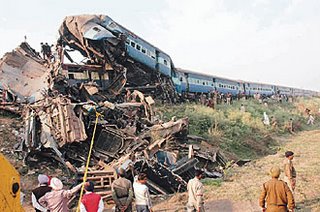
All of us know that a plane crash killing 20 people in the west is much bigger news than a train accident in Chhateessgarh killing 200 in India.


Why?

There is no conspiracy behind it, it is a phenonmenon which can be rationally explained. Why is it that the death of a westerner is more newsworthy than the death of a third-world citizen? Why is it that a plane crash is a bigger accident than a train accident? Why is it that a protest involving 20 people in Capitol Hill gets covered by the worldwide media and a protest involving thousands in a third world country remains unnoticed?

Firstly, news is reported on the strength of its un-commonness and unacceptability. If train accidents, bomb blasts and rapes happen routinely in a third-world country, another of them is no earth-shattering piece of news. It is just routine, and will be covered accordingly. On the other hand, a plane crash in a western country is shocking and unaccpetable. Statistically, it is a rarer occurance. And socially, it is totally unanticipated and unacceptable. The sense of accountability and responsbility is much stronger in the west than in the third world. Citizens don't routinely protest in the western nations, and when they do, it is big news. Contrast this with public protests in a country like India, every city has at least a dozen protests and processions every day. People will lose interest in something which is common.

Secondly, news is an item of consumption. By and large, newspapers and TV channels are vehicles of advertising and marketing supported by the illusion of providing useful information to its readers. The kind of readership and audience decides which news is likely to spur their interest. Report too many news items regarding the poor people or the disenfrenchised, or the quick breeders, and your newspaper and TV channel risk being ignored in favour of another which is more entertaining.

Thirdly, investigation, in depth, of an incident is easily possible only where there is efficient technological and institutional infrastructure to support free and detailed investigation and enquiry. Most news items regarding a tragedy in the west are accompanied with enough details to sustain the interest of a reader. On the other hand, a train accident in Indonesia is just going to be reported in brief because it is going to be extremely difficult to get information about its causes, effects, implications, government response to it, names and details about the victims, etc. On the other hand, vast information is going to be easily available about an incident or the victims in a western society, because the institutions which provide such information are efficiently and professionally run. There are vested interests in suppressing details about an accident or loss of life in an immature society. As such, the "continued coverage" of an incident in the west is much easier and provides much food in terms of new information than in the third world.

Fourthly, individuation makes a tragedy tangible. A literate society which allows its citizens to pursue their interests and creatively contribute to the world around them, would place a higher value on human life than a society which only views people as economical units to be exploited. The accidental death of an IIT professor in India would command national headlines because of the uniqueness of that individual. The motif of uniqueness is much more prevalent in the west than in the east. In media, movies and newspapers, people in the third world are nameless, part of a herd, as good or bad as any of their counterparts. It is not considered a tragedy if a hundred men die who did nothing in their lives but live a traditional, conformant existence. On the other hand, in the west, since the social aspect of life is inferior to the the pursuit of individual goals, an accident has more unique and individual features attached to it. Each accident is, as it were, different, because there were unique individuals in those accidents. The uniqueness is sellable in the media to the multitudes, because of the vicarious nature of the audience. People want to know personal details about the victims, but such personal details will only be meaningful or interesting if the victims were not part of the herd, if they had a tatto on their forearms, if they were part of the local baseball club, if they were to be married soon. These are consumable details. Such details are juicy. The personal lives of such people are richer and more detailed than those of their counterparts in the third world.

Fifthly, the economic impact of an incident is directly proprotional to the resources spent upon its investigation, to its newsworthiness and to the width of its appeal. People who die in a plane crash are near the top of the economic heap. Poeple who die in a second class compartment in a train are near the bottom. The impact of a tragedy which occurs at the top of the heap is wider. The death of a rich owner of an enterprise affects thousands of his employees, the death of a labourer affects only his immediate colleagues and his family. A tragedy is as newsworthy as the people it concerns are influential.

Monday, April 17, 2006

On Sexual Advances

Harassing of women on the street, in public transport and at public places is a world-wide phenomenon. Many people debate as to whether the man is being an animal or is the woman attracting the wrong kind of attention. One comes to see outraged comments from women’s groups claiming their right to wear jeans and shorts in public etc. One notices the rules in effect in institutions and government offices for women to dress “conservatively”.

What is apparent, and what is being left unsaid?

Human evolution to its present state, in which humans have a large brain, capable of sophisticated thinking and planning, has left almost unchanged the genetic and brain structures responsible for instinctual behaviour. Fear, aggression, lust, greed, are endemic in the human condition. In the human species, men have traditionally been the predators (or defenders) in the mid to large scale arena. Women have been no less afflicted with aggression and greed, but their domain of aggression has remained more or less restricted (due to their relatively low physical strength and till recently, low excursive ability in the outside world) to their family and neighborhood.

Instinctually, men view women as objects to satisfy their sexual cravings; whereas women view men as objects to satisfy their emotional, financial and physical needs. The sexual act has long term implications for the woman, but little for the man. The possibility of pregnancy, childbirth and childbearing are of concern to the woman, whereas the man can choose not to get involved.

Men and women engage in preening gestures and attraction tactics in different ways. Men like to display their power and wealth, and women showcase their physical attractiveness and charm.

Now it is typical in most settings that it is men who tease women, try to harass them, make cat-calls, try to touch them, and so on, and not vice versa. Women’s teasing is more covert, by way of provocative dressing, by giving side glances, by a meaningful smile.

Why do men tease so distastefully, and so obtrusively? There are many reasons for that. Firstly, mostly those men engage in such acts who have no hope of attracting the woman by adhering to the rules of the game. Such men are not wealthy, are not high on the social ladder, have had many failures with women. Hence, their desperate aggression and their harassing tactics. Obviously, women are not attracted by such gestures. But how do such men go about civilly attracting the women (that they so tease)? I am not defending these men, but trying to show the reasons for their behaviour. The teasing and harassing begins when they don’t know how to make themselves look attractive, when they know they are inferior (psychologically or factually), when they know they stand no chance against a “worthy” contender.

Secondly, the more conservative a society, the more frustrated one’s sexual instincts. In absence of natural outlets for one’s sexual desires, criminal tendencies enter the picture. Surreptitious fondling, groping, making obscene phone calls, being an anonymous stalker, being a persistent jerk, are typical male gestures in face of sexual frustration. Women are more reticent about openly displaying their frustration because the cost of shedding their inhibitions is too high. They would not get a good (as in, one with a long term commitment, emotionally stable, financially successful) sexual partner, if they lower their bar, so to say. The rules of the game are that your worth is known by whom you are willing to accept. For men, acceptance is easy. They can have sex with a hundred women and forget about them. For women, it is not so easy. Their genetic make up makes each relationship an emotional experience. The feeling of being a slut who can sleep with anybody erodes their self-worth in a deep way. There are ways to cover up this erosion, but it takes its toll.

In neo-elite settings (e.g. a party of Bollywood stars) also, harassment, violation and rape happen. Why? Cultural habits die hard. Once a woman is seen to be dressed provocatively, is easy to talk to and to dance with, and to touch, the man in such settings assumes she is available and willing. Such assumptions are frequently incorrect, but are justified given the over-all cultural milieu from which the neo-elite come.

That is why, until recently, couples did not go beyond embracing in Indian movies. To do otherwise would attract public ridicule and voyeurism towards the actress. The vast majority of Indian populace has not seen intimacy in public, considers it prurient (but therefore, secretly enjoys watching others). Sex, intimacy, french kissing, dancing in the rain, being in love and singing lusty songs, are phenomena that we ourselves crave for, but condemn in others.

Men want to attract and have sex with as many women as possible, whereas women want to “hook” the right man. There is a difference in aims, in the area of focus, and in the repercussions of rejection and desertion.

The strategy of woman, in general, is to passively excite the man. Whereas, for the man, attracting the woman is explicit, he has to “make the move” (at least in most settings), he has to prove himself by overt acts.

But the strategy of women to provoke and excite the man, and the class division in men, means a lot of men would be excited whom the woman does not consider worthy. To ward off unwanted advances is the main chore of which women complain. If the advances become intrusive in nature, so much the worse.

However, the unfortunate thing is that even if the woman is acting non-provocatively, there will be frustrated men who will make advances upon her.

Now, in order to widen her reach, a woman has to be provocative all the time (after all, the right man may be found anywhere), if not by her gestures and such (which take constant effort), then by wearing charming clothes, perfumes, make-up and the like. Her dressing up is purportedly to look good in order to attract the man whom she would be willing to go to bed with, but what about the scores of other men who would be attracted and found wanting by her?

Rejection of one's advances is hurtful, it is a demonstration of one's inferiority. Hardly any man can take a woman's rejection stoically. And when it is known to the man that he would be rejected, what is to stop him from being vile about his advances, so that he can at least annoy, harass and tease the woman with whom he anyway stands no chances? Men like encounters in which they are anonymous (groping furtively in a public bus, for example) or when they are part of a group, so that their ego is secure against reprimand and rejection.

Women would like the legal authorities and police to protect their right to attract the man of their choosing and to be able to get away with rejecting a number of others. And of course, the law should protect them from criminal assault and harassment. But protecting, punishing or deterring men who break the rules does not take away the situation in which men are competing for women (and vice versa).

Laws and morals are meant to keep the animal instincts in check, but nobody would assert that they lead to demise of the instincts.

As long as the instincts are alive and kicking, rapes and murders and harassment and child abuse and flesh trade and trafficking of women and pornography and fantasizing and masturbation and provocative behaviour and eve teasing will continue.

Women rightfully demand that men abide by the laws. But if a man sees the dice loaded against him, he would abide by the rules unwillingly. And given a chance, he would break the rules. So what can women do? Should they dress “conservatively”, wear a veil, wear no make-up, allow their parents to choose their husband, never venture outside the home?

Of course not.

They should understand how provocation works, how almost all men are looking for another woman to fuck, how just touching a woman's body provides pleasure to a man, how remaining anonymous protects a man, the nature of outrage they themselves feel when violated, how their outrage and the male behaviour are both ingrained responses to stimuli.

There is no easy solution to prevent this nuisance. But it can be made unlikely by careful behaviour by women and by proper patrolling of public areas, elderly women and men acting as anonymous guardians of law in public places, workshops on dealing with the other gender in educational institutions etc. Women can shout loudly to attract attention when they feel a violation happening but they must try to tell the man individually first. Often, a random touch of someone's body against a woman's body (in a bus, for instance) has resulted in a public protest by her without first giving the man the opportunity of moving away from her. Sometimes over-zealous people close-by can resort to lynching of a (possibly innocent) man if he is pointed out by a woman. If nothing else, there is loss of face.

Regardless of whether a man is guilty or not, loss of face would mean further insecurity, further erosion of his self-image, and indulgence in further surreptitious criminal tendencies.

A remarkable facet of this issue is how courtship is shown in Indian movies. Uncouth, loud, childish, un-intelligent but smart and sassy heroes try to woo the heroine by unwanted gestures, seemingly unwelcome advances, forced kisses, by stalking, etc. The heroine finds all this annoying, but in a coy way. She secretly wants the hero to do all this and to woo her. Is it a wonder that such movies give ideas to the illiterate masses? The reticence and no-no of a woman is taken to be her coyness, rather than her rejection. And lo and behold, finally she does accept and fall for the guy who pursues her by hook or by crook. The villain in many Indian movies, is rejected for no other reason than that he has an evil face and tries to act too cocky with the heroine. Cockiness is permitted as an agreeable act, but only to the one towards whom the heroine looks favorably already. The hero, whatever he does, is found charming. The villain, whatever he does, is found vile. Such movies perpetuate the mind-set that all is permitted in love.

...

The problems of the real world cannot be solved. They can only be eliminated by moving to the actual.

Saturday, April 08, 2006

On Being a “Morning Person”

As I have passed through the urban landscape in the west as well as the east, I have come to note a curious statement that many people make when they are sleepy or lethargic in the morning. The statement is: “I am not a morning person.”

The birds and bees and animals and fish are not “morning” or “evening” creatures. They live by necessity and by an inner rhythm of wakefulness and sleep. The vast majority of humankind also has little choice in this matter. To earn their bread, people get up early, tend to their duties and start working by 8 or 9 o'clock.

Weekends and vacations are a relatively recent phenomenon in human societies. In agrarian settings, vacations are non-existent. If the crops need tending to, there is no weekend or Sunday
when you can choose to have a “day off”.

Urban life is a life of pressure. A synonym of urban life can be, “So much to do, so little time.” Frenetic activity, stresses to handle deadlines, obligations, commitments, engagements, meetings, shopping trips, parties, visits to places of “amusement”, calculated ways to spend one's weekend, all lend a rather non-leisurely tone to one's life. There is hardly any time to sit back, without anything to do, without phones ringing, without a thousand things on one's mind, and to reflect on nothing.

Of course such a life takes its toll on the physical organism. As mental stresses predominate the life of urbanites, physical activity becomes a way to take one's mind off the “usual stuff”. Going to gyms, yoga, doing weights, jogging, morning walks, after dinner strolls are predominantly urban phenomenons.

And one must not forget the over-indulgence involved in such a life. Overeating, binging, partying, staying up late, “playing hard” after “working hard”, take their toll on one's body.

The body, due to all this abuse, and the mind, due to all this stress, craves relief and escape. And if nothing else, the city offers plenty of escapes. Movies, bookstores, theaters, coffee shops, long drives, window shopping, pubbing, and of course, sleep.

The body, when stressed, needs proper rest to regain its balance. And in urban settings, it is usually short of sleep and rest. It is a rarity to find a modern, employed person who frequently gets up early in the morning (before five o'clock) in a city setting.

And this is to be expected.

However, the identity within, sees the damage being done to the body, and the lethargy the body feels every morning, the reluctance to go to work, the “Monday morning sickness”, the tendency to fall asleep at the workplace; but is loath to admit that the goals it is pursuing are harmful. For to admit that one is living wrongly means one has to get off's one back and actually do something about it.

Hence, it invents a justification of not being a “morning person”. There is, in actuality no such thing as being a “morning person” or an “evening person”. Otherwise, why do we find a predominance of people in the cities who claim they are “not morning people.” And why does one even hear this phrase, if not as a justification of being lethargic and sleepy in the morning? One almost never hears the phrase, “Oh, you know, I just can't stay in the bed once I am awake.” If the body has had proper rest, it is naturally relaxed, calm and ready for activity every morning. Having a cup of tea in the morning to shake off the lethargy, postponing the act of bathing, being constipated, all point to the abuse the body is being subjected to.

What is important is to live a stress free life, a leisurely life, a life free of cares. Living a life otherwise and then justifying it with false assertions about one's body's rhythms is detrimental in the short as well as the long term.

Saturday, December 24, 2005

Disagreement and Tolerance

“Let’s agree to disagree.”

“Hinduism is known for its acceptance of other faiths.”

“Tolerance is a virtue.”

“Respect others’ beliefs, do not hurt their sentiments.”


The above assertions, prescriptions and exhortations are based on a view of human condition which perpetuates the misery and malice all around us.

Facts cannot be disputed, if there be a dispute there is usually a definite way to settle the dispute. Beliefs can not be proved (otherwise they would no longer require the act of believing).

One can disagree only about whether one believes in a certain opinion or not. To disagree about facts is just madness.

Regarding what is still unknown, there are many choices, based on the importance of knowing about the matter at hand. In science one usually hypothesizes and then tests that hypothesis by experimentation. In other cases, one generalizes based on past experience and generic knowledge about the processes involved (for example, in boarding a train expecting that it will reach the destination), in still other cases, one can accept one’s ignorance and carry on.

Beliefs, in the sense I mean them, are emotional investments in certain unverifiable opinions.

It is sensible to see the cause of a belief and one’s (or another’s) emotional stake and involvement, and it is silly to just agree or disagree with it. Both agreeing and disagreeing with a belief leave intact the process of belief and emotional vulnerability, and perpetuate the sense of a separated identity with its opinions and subjectivity.

Accepting or agreeing with another’s faith is foolish. It might make the other feel better, but what has been accomplished? Instead of enquiring into the facts of the matter, the available evidence and its implications, one reacts emotionally (for example, following the hoary adage that “you may win the argument, but you have lost a friend.”) instead of rationally.

Isn’t it evident when two people are arguing about a metaphysical belief, that they are not at all concerned about the facts or the truth of the matter, and that their aim is merely to forcefully and wittily present their case and to convince the other person by every kind of manipulation? Isn’t it evident that the parties have an emotional stake in the matter? A “heated” debate tinged with anxiety, agitation and pugnacity surely indicates that feelings are involved.

In a similar vein, tolerating other faiths and superstitions might be great for a facile harmony and a temporary truce but the very fact that there is a phenomenon requiring tolerance makes it obvious that it somehow pinches oneself. What is the need to tolerate something if it is of no consequence to oneself? The very need of tolerance, patience and equanimity indicate that the basis of antipathy is alive. Merely applying these cover-ups over an essentially malicious nature accomplishes at best a tense equilibrium.

One frequently reads about peoples’ religious sentiments getting hurt, judges issuing restraining orders on the publication of a book or on the screening of a movie on the grounds that it offends the public morality or sensibilities.

While to allow otherwise in animals masquerading as intelligent human beings would be an invitation to civil war, one must look into whether tolerance and acceptance of diverging beliefs is a lasting solution for human peace.

Tolerance is not a virtue, it is only suppression and control of one’s aggression.

Agreeing to disagree might keep alive a friendship, but it also keeps alive the identities involved. Without an identity within, friendship and animosity both are seen as the need-based psychic relationships that they are.

If somebody is psychologically hurt by a word or a statement or an act, then the full and square blame for this hurt lies with the aggrieved party. The other may or may not be malicious in its provocations, but it is certainly up to oneself to not get affected by them.

Nobody is responsible for your psychic suffering and for your happiness than you yourself. To ask others to be sensitive to yourself or to your feelings is to abdicate this responsibility.